Peloton: Pedaling Back to Premium
The consequences of Peloton’s pricing changes in recent years have not only caused significant financial instability but have also tainted the brand’s premium image. Peloton’s upper management navigated the unpredictable conditions of the pandemic by constantly evaluating and altering the pricing of its product lines. However, recent pricing changes in response to slowing demand toward the end of the pandemic have proven to do more harm than good. For long-term stability, Peloton needs to maintain its $44 monthly subscription cost while making strategic adjustments to its hardware pricing.
Peloton experienced an unprecedented surge in sales as stay-at-home orders were implemented. By March 2020, Peloton’s subscriber base had doubled, fueling revenue growth that culminated in a 300% year-over-year increase. Following this boom, Peloton implemented its first wave of price cuts by splitting the bike into two models. The goal was to capture a larger share of the at-home fitness market and make the product more accessible to consumers. However, because Peloton is positioned as a premium brand, these price decreases risked lowering consumers’ perceived quality of the product. Changing prices every year, sometimes even multiple times within a single year, damages brand trust and creates uncertainty around Peloton’s value proposition.
Alongside the erosion of brand image, the most significant issue arose with the price cut in Q3 of 2022. While subscription revenue continued to grow steadily despite price increases, indicating low price elasticity, the reduction in hardware pricing led to a consistent decline in total product revenue. As a result, Peloton became increasingly reliant on subscription revenue to offset losses from hardware sales. This outcome suggests that the price elasticity of demand for the bike was insufficient to drive enough additional unit sales to cover the increased costs.
Peloton must lean into its position within the premium at-home fitness market. Even with lower-priced models, Peloton will never be fully accessible to the average consumer. Budget-conscious customers seeking at-home bikes or treadmills are likely to pursue lower-cost alternatives before considering Peloton. Given the low-price elasticity of demand, Peloton should rebuild its premium brand image by maintaining a higher hardware price point. The bike should be marketed as a luxury product targeted toward middle-class and upper-class consumers, as higher prices reinforce perceptions of quality and brand exclusivity.
As part of this analysis, I considered whether Peloton should charge a monthly subscription fee or move toward a single high upfront price. Peloton should continue charging the $44 monthly subscription fee while condensing its product line to one model per product category at a higher price point. I recommend eliminating the Bike+ and consolidating the lineup into one bike model and one tread model. Because a detailed breakdown of product-level sales was unavailable, I used the standard bike model as the basis for the pricing analysis and focused on identifying a single sustainable price moving forward.
I specifically analyzed the mid-2022 price cut to evaluate its before-and-after implications. Despite rising costs, subscriber numbers continued to increase, while hardware revenue declined following the price cut. Pre-cut product margins were modestly positive, ranging from 6–12%, whereas post-cut margins turned sharply negative, ranging from –11% to –98%. Losses per bike ranged from approximately $165 to over $1,400, with Q4 2022 identified as a clear outlier. Post–price cut breakeven prices ranged from roughly $1,600 to $2,100. The average breakeven price was $2,003, while the breakeven price excluding Q4 2022 was $1,788 (Exhibit B).
To evaluate a more conservative pricing approach, I applied a cost-plus pricing framework using a 20% markup (Exhibit B). This resulted in a price of $2,145, or $2,403 when including the outlier quarter. Given the extreme losses observed in Q4 2022, I do not believe this period reflects Peloton’s normalized cost structure, particularly when compared to margins in earlier years. As a result, I recommend rounding to a final consumer-facing price of $2,099, which avoids awkward pricing while still signaling a premium, luxury positioning.
This pricing strategy allows Peloton to introduce a new product model without public confusion or scrutiny stemming from frequent price changes. It also enables the company to cover hardware costs independently rather than relying on subscription revenue to offset product losses. Ultimately, this approach offers a more sustainable and predictable business model, supporting Peloton’s long-term financial stability while reinforcing its premium brand image in the at-home fitness market.
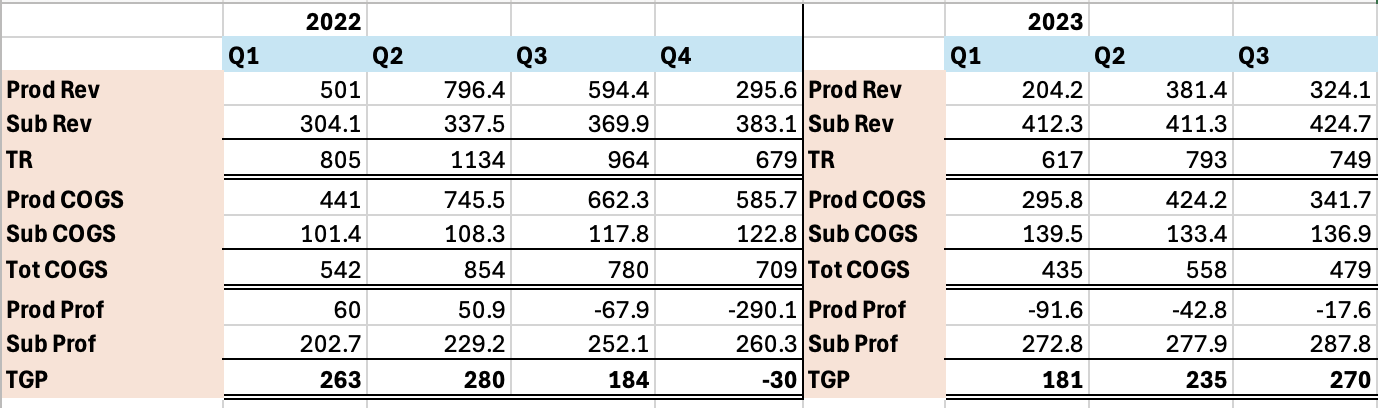
Peloton Revenue, COGS, and Profit

Suggested Cost-Plus Pricing Approach
